Theory of Computation · Week 1 · Lesson 0007 of 7
Mixed drill
Trace, factor, construct and prove across ten mixed questions.
For each problem, write down a trace, a cut, a witness, or a short proof before checking the answer.
1Warm-up
2Figures for the drill
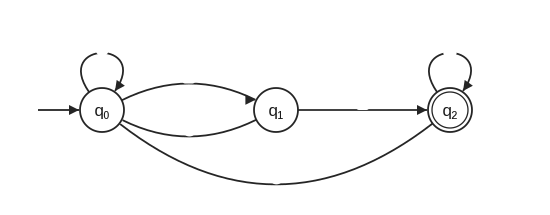
Q5 · DFA
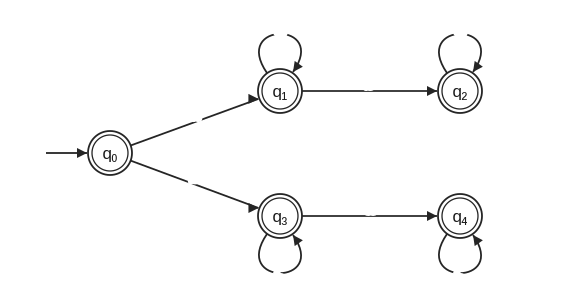
Q2 · NFA
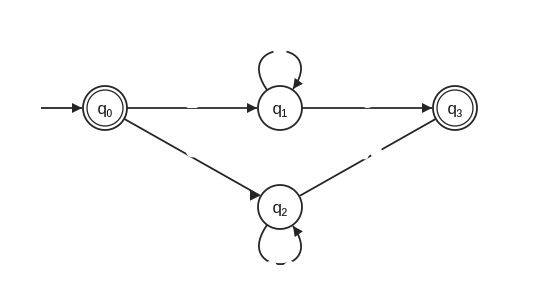
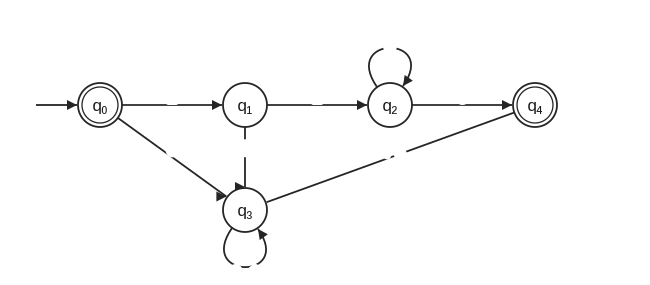
Q8 · DFA comparison
Sipser, Introduction to the Theory of Computation, §1.1–1.4.
3Test a candidate answer
A counterexample to a proposed expression is a word that exactly one of the expression and the machine accepts. Start with ε and short words that take the least obvious edge. For a claim about infinitely many strings, check whether the expression can generate any word, then look for a repeated piece of positive length.
A familiar-looking multiple-choice option can fail on a short word or rely on an unstated condition. Evaluate it with a trace, a count, or a counterexample before accepting it.
When a keyed option and a printed diagram disagree, write one distinguishing input and its state trace. When an infinitude question is missing a hypothesis, state the hypothesis and give an example where the conclusion fails.
4Recap
- For a machine question, trace all input before checking acceptance.
- For a language-operation question, write the cut or set relation.
- For regularity, name the finite information or give a contradiction for every allowed pumping split.
5Check yourself
6Cheat card
- Machines
- DFA: one state. NFA: all reachable states, including ε-closure.
- Sets
- Regular union needs regular inputs. Any finite intersection is regular.
- Expressions
- Read mandatory edges, try cuts, and produce unbounded lengths to prove infinity.
- Proof
- Use a witness for strictness, finite memory for regularity, and pumping to show nonregularity.
- Memory hook
- Trace, cut, witness, or proof. Put one on the page before choosing.